Pages

Showing posts with label Sensory Play. Show all posts

Investigating Water Beads

I've been reading about these on lots of the lovely blogs I follow and knew we had to get some to try at home. They were also featured on QI, a brilliant tv programme in the UK, so the search for them was on! I managed to find some colourless beads on ebay for a couple of quid for 5 packets.

They start out tiny.


We put them into our sensory tub and added a litre of water. Very quickly they began to get bigger. We noticed that when we added more water so that the water was covering the beads, the beads seemed to 'disappear' into the water. It was only when we shook the water or swirled it with our hands that the beads became visible again.


The beads felt slippery and slimy!


 We counted them and tried dropping them into the water from high!


 The beads release water very slowly so we are leaving them in a colander to see if they get smaller.

Homemade Paints

We decided to try out some homemade, edible paints from The Imagination Tree.
* 2 cups of corn flour
* 1 cup of cold water
* 4.5 cups of boiling water
* Liquid food colouring


Mix the cornflour with the cold water and stir together. Pour in the boiling water and stir between each cup. We then separated it into individual pots before adding colouring. Ours haven't turned out as thick as they perhaps should have done, but they look like a good consistencyt for painting on the patio outside!


Mixing and stirring and pouring and measuring... and bunny ears essential!


We used some old finger paint pots to store our edible paints.


Bee was quite interested in tearing up her paper as well as painting on it!

Halloween Play Dough


Basic Play Dough Recipe
1 cup plain flour
1/2 cup salt
2 tablespoons cream of tartar
2 tablespoons veg oil or scented oil- I used vanilla
1 cup water with added food colouring- I used pink and yellow mixed together to make orange for a pumpkin colour.

 
Put all the ingredients in a large saucepan and stir over a medium heat ...


...until the dough forms a ball.


Allow to cool then kneed until smooth.

 
Store in an airtight container. Add glitter for some Halloween sparkle! We used green.


Grab your Halloween cookie cutters...


... and your play dough tools...

  
...and get creating!


Mo Mo loves to use her safety scissors to cut play dough and she uses her felt tip markers to draw on it too.


Sensory Play

All of us learn through our senses and for young children, using their senses is most familiar and basic way to explore, process, and understand new information. Sensory play is play that involves one or more of the five senses-  touch, sight, smell, taste and hearing. Children learn best when they can experience new things in a multi-sensory way as they are accessing the materials through several channels, therefore making learning richer and more varied. Sensory play is an open ended activity and rarely has a finished product or predetermined outcome – therefore it is process driven, providing an opportunity for every child to succeed.  
Through sensory play children can develop:  Fine and gross motor skills through the manipulation of materials e.g pouring, moulding, lifting, carrying and sorting; creativity; self confidence; social skills; vocabulary; self expression; mathematical concepts; investigative skills; cognitive skills - by observation, experimentation, the formulation of solutions to problems and manipulation of the sensory materials.
Amanda Morgan from Not Just Cute has a great blog post on sensory play.
There are also some nice ideas at Nursery Activity Ideas.

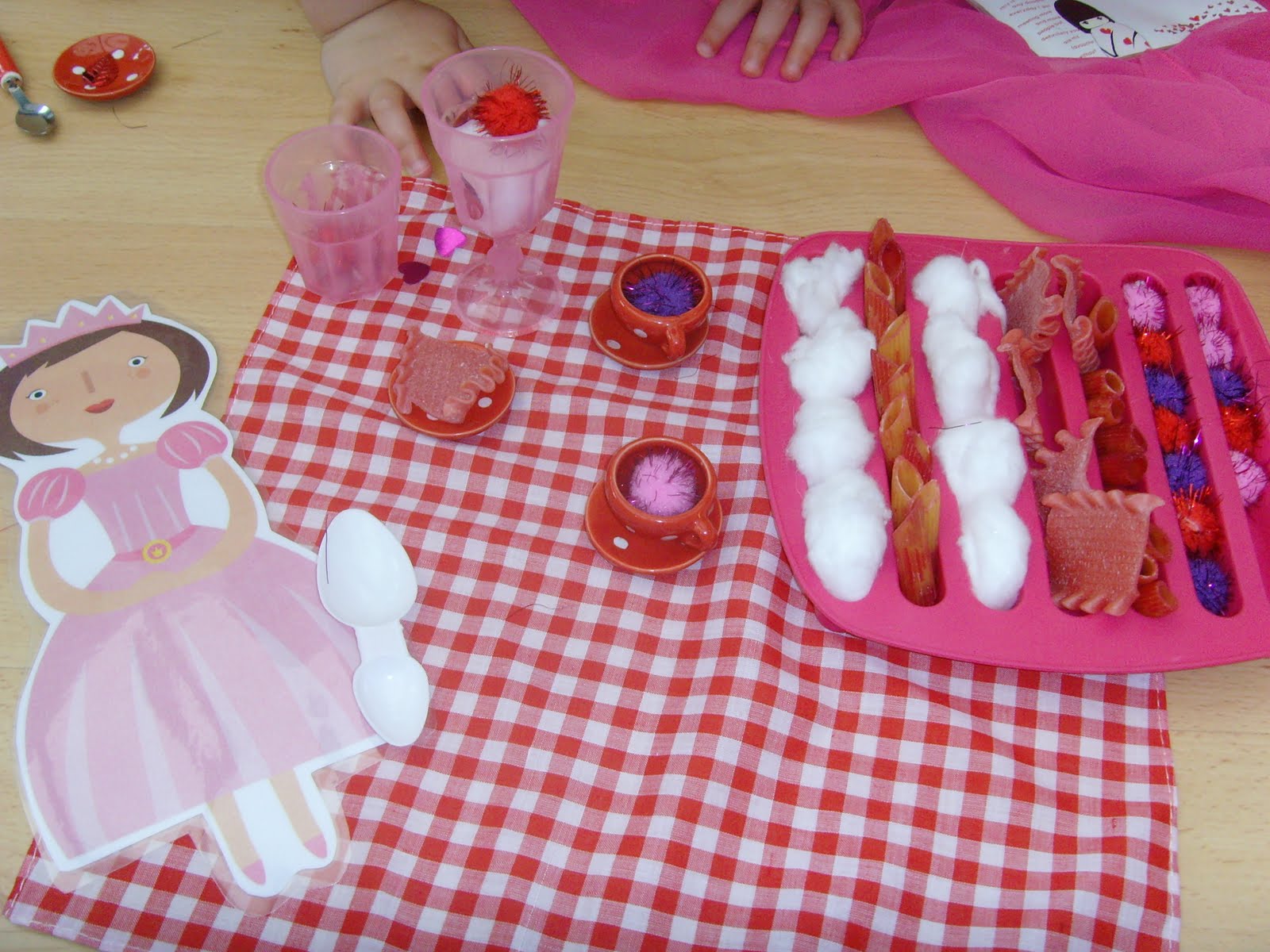
'Princess Tea Party' Sensory Tub!

I've been reading about sensory tubs (or boxes) on various different blogs and felt inspired to try one at home for Mo Mo. I've gone with a general pink theme with a focus on her new porcelain tea set. For the last couple of months, she has been telling people that she's having a 'Princess Tea Party' for her third birthday in November!
What's inside the tub:
  • Birthday cards
  • Pink pasta (I put dried pasta into a sealed bag with some pink food colouring, shook it up and then placed it on a tray to air dry)
  • Pink scarf
  • Pink sequins
  • Pink plastic glasses
  • Spoons
  • Cotton wool
  • A printed out princess (from Mrs Pancake)
  • Wooden cakes
  • Pink cloth
  • Sparkly pink and purple pom poms
  • Pink tissue paper
  • A larger pink plastic drinking cup
  • A jewellery purse
  • A plastic pink ice cube tray
  • A handkerchief in a little zippy bag
  • A porcelain tea set
  • A pink phone


The idea behind a sensory tub or box is that children explore the world through all of their senses (multisensory learning.) The more ways that they can explore the more that children will learn. Sensory tubs  make hands-on exploration of materials accessible to children while containing the mess sometimes associated with it. I guess it's similar to the builder's tray idea, but on a smaller scale for an individual child, rather than groups of children. Interesting textures are put in the box. The box can be themed to relate to your child's interests, the season or something special that is happening. It could, on the other hand, be a selection of random sensory items.

The sensory tub has a base material such as rice. I've put pasta in mine as I just know I'll be finding tiny bits of rice everywhere forever more! Styrofoam peanuts, snow flakes, corn, shells, shredded paper, dried beans or lentils could be used. Spoons and containers are put into the tub for pouring, scooping, measuring etc. Then there are your treasures! So, the 'Princess Tea Party' tub has a small porcelain tea set, a bracelet, an organza bag, some pink sparkly pom poms, sequins and some different pink materials. To add a sense of smell, I have placed a pink cloth with some strawberry essence dropped onto it! Here's a fantastic link of sensory tub ideas from Our Worldwide Classroom so that you can create a new sensory tub each month.

The first thing Mo Mo did with the tub is get each thing out and put it on the floor to see what was in there. "These are like clouds," she said as she took the cotton wool out of the box. Next she put the pasta pieces into the bag and the ice cube tray and arranged the cotton wool balls in a circle on the sparkly foam. The pasta was then put into the little zippy bag and Mo Mo kept saying- "Is that enough?" and "That's too much." She definitely enjoyed opening and closing the zipper. Her interest was kept for about 20 minutes. I have noticed that Mo Mo loves containers. In our tuff spot tray at the moment, we have a selection of boxes and containers of various sizes- some with lids and some without and various bags with draw strings. This has led me to read more into schemas to find out how I can develop Mo Mo's play.


Play

I've been inspired by lovely blogs like 'The Imagination Tree' to learn more about how children learn through play. I had to put something together for my coursework about play and thought I'd post it here so I can add to it and adapt it as I go along...


The right to play is a fundamental human right. ‘Play is a freely chosen, personally directed, intrinsically motivated behaviour that actively engages the child’ (Children’s Play Council).  Play underpins all development and learning for young children. Most importantly, in play children learn how to learn. Play teaches them to explore, investigate, develop all important new skills and master and improve existing skills. They develop intellectually, creatively, physically, socially and emotionally. Through play children learn how to problem solve, negotiate, take risks and overcome obstacles. It is through play that children develop friendships and a sense of belonging to a peer group.
The qualities of spontaneity, wonder, imagination, and trust, are best developed in early childhood play. If we allow adequate time for these early skills to become firmly established, the child will be better prepared to acquire the later more sophisticated skills.
Here are some examples of how children learn through play:
·    Gross motor skills are developed by running, hopping, throwing, moving to music, and balancing.
·    Fine motor skills by drawing, cutting, pouring sand.
·    Cognitive skills by matching and sorting toys by colour, from water to land animals, by listening and following directions.
·     Social skills through interactions with other children through play and listening to stories and acting out stories.
·     Language development through interactions, listening to and singing songs.


By observing children at play we gain understanding of who they are and what they can do. We learn a lot about their personalities, feelings and temperaments. We can find out what the children have already learnt and what they are learning. We can discover: their interests and preferences; how we can support their interests in the setting and how we can extend their interests (and also what changes in their environment could best assist their development); their developmental levels (cognitive and social); how they relate to other children and adults; what strategies children use to attain their goals; which skills the children need to practice; whether the activities planned are at the right level and we can learn how the setting has contributed to the play experience. We learn what experiences they bring to the play, for example, we may learn about a child’s home culture.

      Childcare practitioners observe and interpret children’s behaviours in order to understand them, and in doing so, help them to understand themselves and the world around them. However, children's play is complex, and we need to be cautious about assuming that, because we have observed what the children are doing or saying, we have accessed their ideas and thoughts. We need to be careful that we see what actually happens and not what we expect or want to see.


Treasure Baskets


Last week I decided it was time to get the Treasure Basket out for Bee since she is now 6 months old! I propped her up in her play ring as she is not quite sitting up by herself yet. I based it on a wooden theme (apart from the butterfly- bought from a lovely shop in the Outer Hebrides last year!)  I noticed that Bee played with the basket the first day it was out and really explored the items with her hands and mouth.  However, the basket has been out since and she hasn't really been back to it much. Time to re-acquaint myself with the theory behind treasure baskets:
  • Heuristic play is about exploring objects from the real world- natural and household items (not plasic toys which taste, smell and feel the same- giving little sensory feedback)
  • The treasure basket objects should be chosen to stimulate the senses
  • The baby makes their own choices about which items to explore (with the adult sitting nearby but not showing them how to play)
  • Clear a space, away from other distractions
  • The treasure basket should never be left out 24/7 for your baby to play with, as they will soon bore of the objects and become uninterested in them (this is where I have gone wrong!)
  • Over time, objects can be added as you find them, for example:-
  • Paper / cardboard objects: Egg boxes, notebook, sturdy cardboard tubes, small boxes that will fit inside each other
  • Wooden objects: Door wedge, small turned bowl, dolly pegs, egg cup, wooden egg, spoons, curtain rings, coaster, bracelet, block, napkin rings, dowel, empty salt and pepper cellars.
  • Leather, textile, rubber, or fur objects: Small knitted toy, bean bag, piece of flannel, velvet powder puff, bags of herbs, bag of lavender, leather key ring, coloured ribbons, leather purse.
  • Rubber objects: Ball, bath plug with chain, soap holder, door stop, coaster.
  • Metal objects: Honey drizzler, an egg cup, curtain ring, egg poacher, measuring spoons, tea strainer, whisk, powder compact, bells, lemon squeezer, small bowl, jar tops
  • Natural objects: A lemon or orange, coconut shell, grass rope, sheepskin, pumice stone, loofah, shells, pine/fir cones, driftwood, avocado stone, large pebbles, corks
  • Brushes: Scrubbing brush, pastry brush, baby's hair brush, nail brush, makeup brush, paint brush, shaving brush, wooden toothbrush.
  • Other objects: small vanilla essence or food colouring bottle, hair rollers, small mirror, scent bags, bone shoe horn, ceramic bowl
Great information on Treasure baskets here- Little Acorns To Mighty Oaks

I forgot that I have the Little Book of Treasure Baskets which has a great section on treasure baskets for older children relating to the EYFS areas of learning. I do have a storage box where I collect bits and bobs that I can use to make different themed treasure baskets. I need to put more items in the treasure basket and jest get it out for a 30 minute or so session each day when Bee looks interested rather than leaving it out the whole time.

Cake Pops


Makes: 12-14

Prep time: 30 mins
Cooking time: 1 hr 30 mins plus chilling time
Skill level: Bit of effort
Costs: Cheap as chips

Ingredients


You can use ready-made cakes as the base for your cake pops to save time

185g butter, softened


185g caster sugar

3 medium eggs, beaten

275g plain flour

1 tsp baking powder

Lemon or orange extract

Sparkle sugar (like Dr. Oetker Shimmer Sugar)

6 level tbsp of vanilla buttercream

3 x 150g bars of white chocolate

Pack of 15 20cm lolly sticks


Method

Preheat oven to 160ÂșC/Gas Mark 3.

Line an 11cm x 22cm loaf tin with greaseproof paper.

Cream butter and sugar until light and fluffy. Add eggs one at a time with a spoon of flour and mix well.

Add rest of flour and baking powder and mix until all incorporated. Add a few drops of lemon/orange extract to taste.

Bake in oven for 75-90 mins until firm to the touch. Remove from tin, place on a cooling rack, cool completely and remove the paper.

Remove all the golden outer surfaces of the cake to leave just the pale coloured sponge and break into crumbs.

Mix the crumbs and the buttercream together to form balls - if they are a little crumbly add a little more buttercream.

Roll into 14 balls and place on a tray, cover with cling film and chill for at least 30 minutes.

Melt the bars of chocolate and dip a lolly stick into the melted chocolate to coat about 2cm of stick. Gently push a stick into the centre of each cake ball.

Dip the ball into the melted chocolate, coat all over and roll in the shimmer sugar.

Secure the sticks into a block of polystyrene or florists oasis and allow the cake pops to set before eating.


Strawberry Play Dough


We used a basic play dough recipe and added pink food colouring and strawberry essence to give our new batch a lovely smell! I found some cup cake cases in the cupbord and Mo Mo and I made little cakes. We used pipe cleaners as candles and red glitter as sprinkles. We then set up a shop with the play till and shopping baskets. I was the customer and Mo Mo the shopkeeper who sold me lots of lovely cakes! We used plastic play coins to spend in our shop. Mo Mo used lots of fab language like, "Would you like a bag?", "How many would you like?" She counted out the cakes and used the phrase, "One more." With my teacher head on, lots of fantastic sticky notes moments linking to the EYFS!
Related Posts Plugin for WordPress, Blogger...